E-invoicing via NemHandel and Peppol: How to receive invoices that post themselves
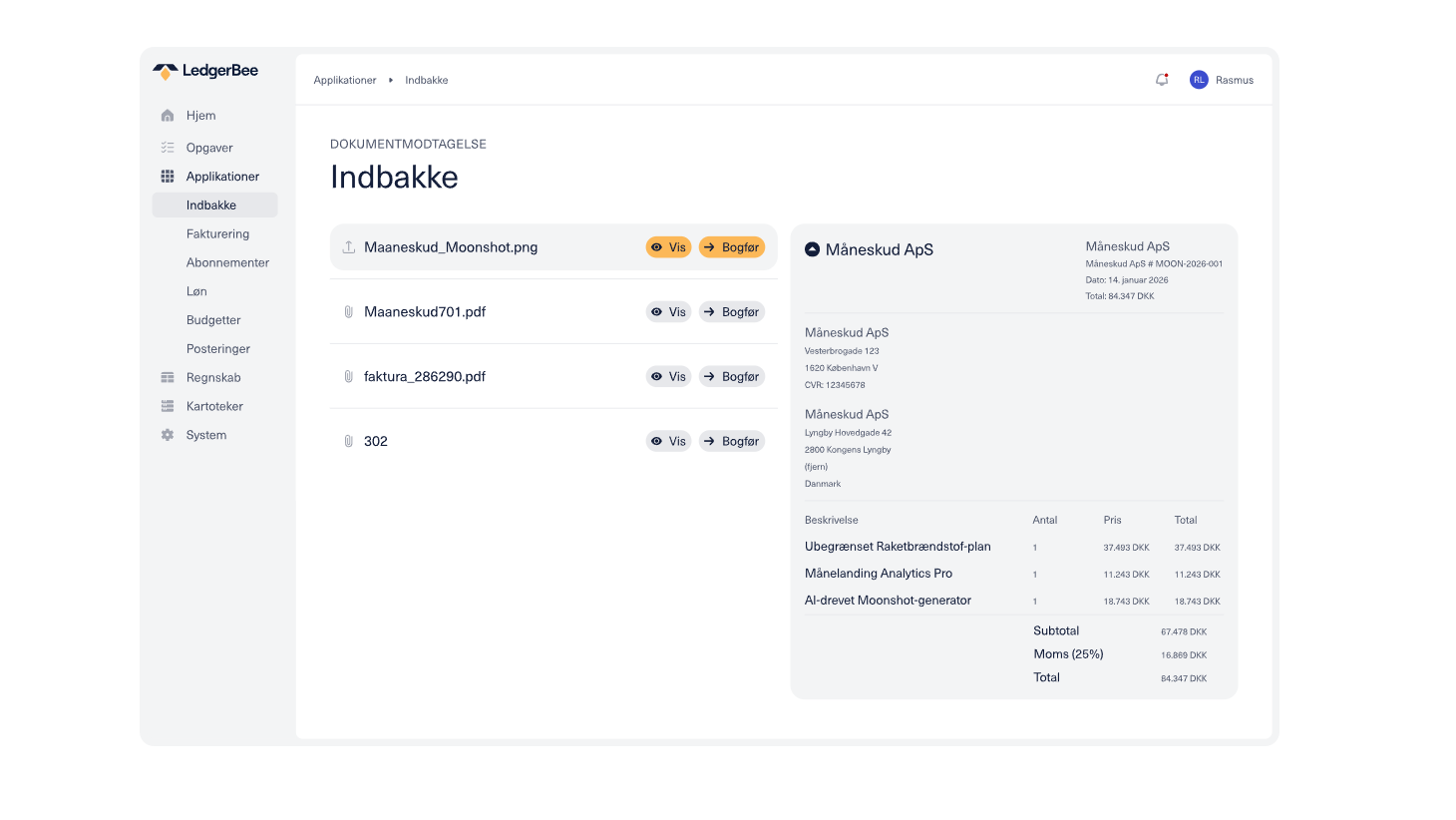
A PDF invoice is a photograph of an invoice. Everything is there, but your finance system cannot use a single number until it has been read.
An e-invoice via NemHandel or Peppol is the numbers themselves. It lands directly in the system, is coded and sits ready for approval while you do something else. That is the difference between manual work and automation.
This article is about receiving e-invoices – not about sending them. It is part of our guide to automated invoice processing.
What are NemHandel and Peppol?
Term — What it is
NemHandel — Denmark's shared infrastructure for exchanging business documents between businesses and public authorities. Mandatory for e-invoices to the public sector since 2005.
OIOUBL — The Danish document format for e-invoices and credit notes.
Peppol — The international network and document format (Peppol BIS) used in most of Europe.
NemHandelsregisteret — The recipient register – and at the same time Denmark's address register in Peppol. If your CVR number (the Danish company registration number) is listed there, suppliers can send e-invoices straight into your finance system.
NemHandel consists of three parts: shared document standards (OIOUBL and Peppol BIS), a shared recipient register and a transport layer built on the European standard eDelivery AS4. All traffic goes through approved access points, and the Danish Business Authority (Erhvervsstyrelsen) is the Danish Peppol authority, responsible for approving them.
What does the law require?
The Danish Bookkeeping Act (bogføringsloven) defines an e-invoice as an invoice or credit note in a structured, electronic format that can be processed automatically (section 3(8)). The Danish Business Authority puts it plainly in its guidance: image files – including PDFs – are not e-invoices.
The law places requirements on the system, not on you:
- Your digital bookkeeping system must be able to automatically send and receive e-invoices and credit notes via NemHandel in OIOUBL format and in Peppol BIS format.
- If you use a registered standard system, it is the provider's responsibility that the requirement is met. If you use a custom-built system, it is your own.
- You are not obliged to use e-invoicing. The system must be able to do it – whether you do is your choice.
That choice is changing character. The requirements for digital bookkeeping are now fully phased in, and on 1 July 2026 the Danish Business Authority sent a draft amendment to the executive order on requirements for these systems out for consultation, with planned entry into force on 1 January 2027. Three main points:
- Registration becomes the default. Providers of standard systems must register their customers to receive e-invoices in NemHandelsregisteret unless the customer actively opts out – within four weeks, according to the draft. Those registered can always deregister again.
- E-invoice is shown first. When you invoice from the system, it must check whether the recipient is registered and, if so, show e-invoice as the first choice.
- New security requirements. Identity verification, mandatory master data on documents sent from the system, and restrictions on who can change company details.
If the draft goes through, the PDF invoice becomes the exception that the supplier has to actively choose.
From OIOUBL to Peppol
In March 2026, the Danish Business Authority published a new document strategy: the Danish OIOUBL format is being phased out in favour of NemHandel BIS 4, which is the European standard Peppol BIS 4 with Danish additions. The purpose is to comply with the European standard for e-invoicing (EN 16931).
- 2028–2029: Transition to NemHandel BIS 4 for invoice, credit note and invoice response.
- Mid-2029: The transition is expected to be fully completed, and OIOUBL is phased out.
- The requirement in the Bookkeeping Act to support OIOUBL is removed once the transition is completed.
The EU is pulling in the same direction. With the ViDA Directive (2025/516), adopted on 11 March 2025, structured e-invoices under EN 16931 become mandatory for all cross-border B2B trade in the EU from 1 July 2030.
For you as a recipient, it means nothing right now. The format change is the provider's job. What you can do is choose a finance system that already handles Peppol BIS today.
Get your suppliers on board
Being able to receive is not the same as receiving. Suppliers send PDFs until you ask for something else.
- Register your CVR number in NemHandelsregisteret. This is usually done directly from your finance system and typically requires MitID Erhverv. In LedgerBee, you start the registration under System > Integrations, where NemHandel and Peppol run via Sproom. If you have an EAN/GLN number, register that too – it is the address many suppliers know from trading with the public sector.
- Activate Peppol. Then foreign suppliers can send structured invoices too.
- Write to the suppliers that send the most invoices. Sort your suppliers by number of vouchers and take the top of the list first. One email to them moves more than a note in your signature.
- Make it a requirement for new suppliers. Write it into your purchasing terms and on the order confirmation.
- Make it easy for them. All registered Danish bookkeeping systems must be able to send e-invoices. The supplier usually just has to select your CVR number as the recipient in their own system.
Fewer errors, less fraud
A PDF has to be interpreted. Scanning, OCR or AI reads the amount, date and lines – and the result has to be checked. An e-invoice does not have to be interpreted. It arrives as structured data with the supplier's CVR number, invoice number, lines, VAT, due date and payment details in fixed fields that the system reads directly.
In practice, that means three things:
- No reading errors. Amounts and VAT codes are in fields, not in pixels.
- Automatic matching. Supplier and lines can be matched against supplier master data, contract or purchase order without manual steps.
- Known sender. Finance Denmark (Finans Danmark) points to two typical forms of business fraud: fake invoices for small amounts and "changed bank details" from a fake supplier. Both come in by email. An e-invoice comes via an approved access point with the sender's CVR or Peppol ID – and the consultation draft adds identity verification and fixed master data on top. Finance Denmark's own advice, incidentally, is to keep the number of manual payments down with an automated payment system.
What remains is approval and payment. How those steps are automated is covered in the guide to automated invoice processing.
Frequently asked questions
Is it a legal requirement to receive e-invoices?
No. Your bookkeeping system must be able to receive them, but you decide for yourself whether you use the function. The Danish Business Authority has proposed that registration becomes the default, with the option to opt out, from 1 January 2027.
What is the difference between NemHandel and Peppol?
NemHandel is the Danish infrastructure, Peppol the international one. NemHandelsregisteret is also the Danish address register in Peppol, and with NemHandel BIS 4 the Danish format becomes a variant of the Peppol standard.
Do I need an EAN number to receive e-invoices?
No. Registration is by CVR number. An EAN/GLN number can be added if your suppliers prefer to send to that.
Want to see how an e-invoice lands ready for approval? Book a demo
Sources: Executive Order on requirements for digital standard bookkeeping systems (BEK no. 97 of 26 January 2023) · Danish Business Authority – Requirements for digital standard bookkeeping systems · Danish Business Authority – Guidance on non-registered digital bookkeeping systems · Danish Business Authority – Nemhandel – shared digital infrastructure · Høringsportalen (the Danish consultation portal) – Draft amendment to the Executive Order on requirements for digital standard bookkeeping systems, case no. 2025-11688 · NemHandel – Strategy for the document standard for e-invoices, 5 March 2026 · Peppol.org – Denmark · Council Directive (EU) 2025/516 (ViDA) · Finance Denmark – Business fraud